
What is Half-Life? | Calculations, Atom decay, Real-World Application, Origin and many more

What Is Half-Life?
The Complete Science Breakdown
From radioactive atoms to life-saving drugs — a full, beginner-friendly guide to understanding half-life across all branches of science.

Definition
What Is Half-Life? A Clear Definition
In science, half-life is the amount of time it takes for exactly half of a given quantity of a substance to decay, transform, or be eliminated. Represented by the symbol t½, it is one of the most important concepts in nuclear physics, chemistry, pharmacology, and environmental science.
Think of it this way: if you start with 100 grams of a radioactive substance that has a half-life of 10 years, after 10 years you will have approximately 50 grams remaining. After another 10 years (20 years total), you will have 25 grams. And so on — each period cuts the remaining quantity in half.
The term was originally coined as "half-life period" by physicist Ernest Rutherford around 1907 during his pioneering research into radioactive decay. The phrase was shortened to simply "half-life" by the early 1950s. Today, it is applied far beyond nuclear physics — it shapes how we understand drug metabolism, environmental cleanup, chemical reactions, and even electronics.
History
The History and Origin of Half-Life
Understanding the history of half-life helps students appreciate why it became a cornerstone concept in modern science. It did not emerge from abstract mathematics — it was born out of hands-on experiments with radioactive materials.
Radioactivity Discovered
Henri Becquerel discovers that uranium salts spontaneously emit radiation, marking the birth of nuclear science.
Marie & Pierre Curie
Marie and Pierre Curie isolate polonium and radium, demonstrating that radioactive decay is a property of specific atoms.
Rutherford Defines Half-Life Period
Ernest Rutherford formally introduces the concept of the "half-life period" while studying radium decay to lead-206, using it to date geological rock formations.
Carbon-14 Dating Developed
Willard Libby uses the known half-life of Carbon-14 (5,730 years) to develop radiocarbon dating, revolutionizing archaeology and geology.
Term Shortened & Formalized
Scientists formally adopt "half-life" (dropping "period") as the standard term; it enters pharmacology to describe drug elimination rates.
Universal Scientific Concept
Half-life is now applied in medicine, environmental science, engineering, food safety, and nuclear energy — one of the most cross-disciplinary ideas in all of science.
Mathematics
The Half-Life Formula: The Math Behind the Concept
For students, understanding the half-life formula is essential. Fortunately, once you understand what each symbol means, the math becomes very manageable. Half-life is rooted in exponential decay — a mathematical process where a quantity decreases by a constant proportion over equal time intervals.
The Core Exponential Decay Formula
The most important half-life equation is:
This formula tells us exactly how much of a substance remains after any given time period. If you know the initial amount and the half-life, you can calculate the remaining quantity at any point in time.
Relationship Between Half-Life, Decay Constant, and Mean Lifetime
There are three closely related parameters used in exponential decay calculations:
Three Key Parameters
- t½ (Half-life): Time for quantity to reduce to 50% of its original value.
- λ (Decay constant): The probability per unit time that an atom will decay. Related to t½ by:
λ = ln(2) / t½ ≈ 0.693 / t½ - τ (Mean lifetime): The average lifespan of a single particle before decay. Related by:
τ = 1/λ = t½ / ln(2)
Worked Example
Suppose a radioactive sample starts with 800 grams and has a half-life of 5 years. How much remains after 20 years?
Step-by-Step Calculation
- Number of half-lives elapsed = 20 years ÷ 5 years = 4 half-lives
- Apply formula: N(t) = 800 × (1/2)⁴ = 800 × (1/16)
- Result: N(t) = 50 grams remaining
Half-Life Decay Table
| Half-Lives Elapsed | Fraction Remaining | Percentage Remaining |
|---|---|---|
| 0 | 1 / 1 | 100% |
| 1 | 1 / 2 | 50% |
| 2 | 1 / 4 | 25% |
| 3 | 1 / 8 | 12.5% |
| 4 | 1 / 16 | 6.25% |
| 5 | 1 / 32 | 3.125% |
| 7 | 1 / 128 | 0.78% |
| 10 | 1 / 1,024 | 0.098% |
Nuclear Physics
Radioactive Half-Life: How Unstable Atoms Decay

Radioactive half-life is the original and most widely recognized use of this concept. In nuclear physics, certain atoms — called radioisotopes or radionuclides — are inherently unstable. Their atomic nuclei release energy (radiation) as they transform into more stable configurations. This process is called radioactive decay.
The half-life of a radioactive isotope is a fixed, measurable property. It does not change based on temperature, pressure, chemical environment, or any external factor. This makes it extremely reliable for scientific calculations and dating purposes.
Types of Radioactive Decay
Main Decay Modes
- Alpha Decay (α): The nucleus emits an alpha particle (2 protons + 2 neutrons). The atom transforms into a different element. Example: Uranium-238 → Thorium-234.
- Beta Decay (β): A neutron converts into a proton (or vice versa), emitting a beta particle (electron or positron). Changes the element's atomic number.
- Gamma Decay (γ): The nucleus releases high-energy electromagnetic radiation without changing its atomic number or mass. Often occurs alongside alpha/beta decay.
Half-Lives of Common Radioactive Isotopes
| Isotope | Symbol | Half-Life | Decay Type | Common Use |
|---|---|---|---|---|
| Carbon-14 | ¹⁴C | 5,730 years | Beta | Radiocarbon dating |
| Uranium-238 | ²³⁸U | 4.47 billion years | Alpha | Geological age dating |
| Iodine-131 | ¹³¹I | 8.02 days | Beta + Gamma | Thyroid cancer treatment |
| Cobalt-60 | ⁶⁰Co | 5.27 years | Beta + Gamma | Cancer radiotherapy |
| Technetium-99m | ⁹⁹ᵐTc | 6 hours | Gamma | Medical imaging (PET scans) |
| Plutonium-239 | ²³⁹Pu | 24,100 years | Alpha | Nuclear fuel/weapons |
| Polonium-210 | ²¹⁰Po | 138.4 days | Alpha | Research; historically notorious |
| Francium-223 | ²²³Fr | 22 minutes | Beta + Alpha | Scientific research only |
Why Is Radioactive Half-Life Constant?
A common question among students is: why doesn't the half-life of a radioactive substance change when you heat it, freeze it, or apply pressure? The answer lies in the nucleus. Radioactive decay is a nuclear process, not a chemical one. It is driven by the forces within the atom's nucleus, which are completely unaffected by the electron shell chemistry happening outside. External conditions simply cannot reach the nuclear level with enough force to alter decay rates.
Pharmacology & Medicine
Biological Half-Life: How Your Body Processes Substances
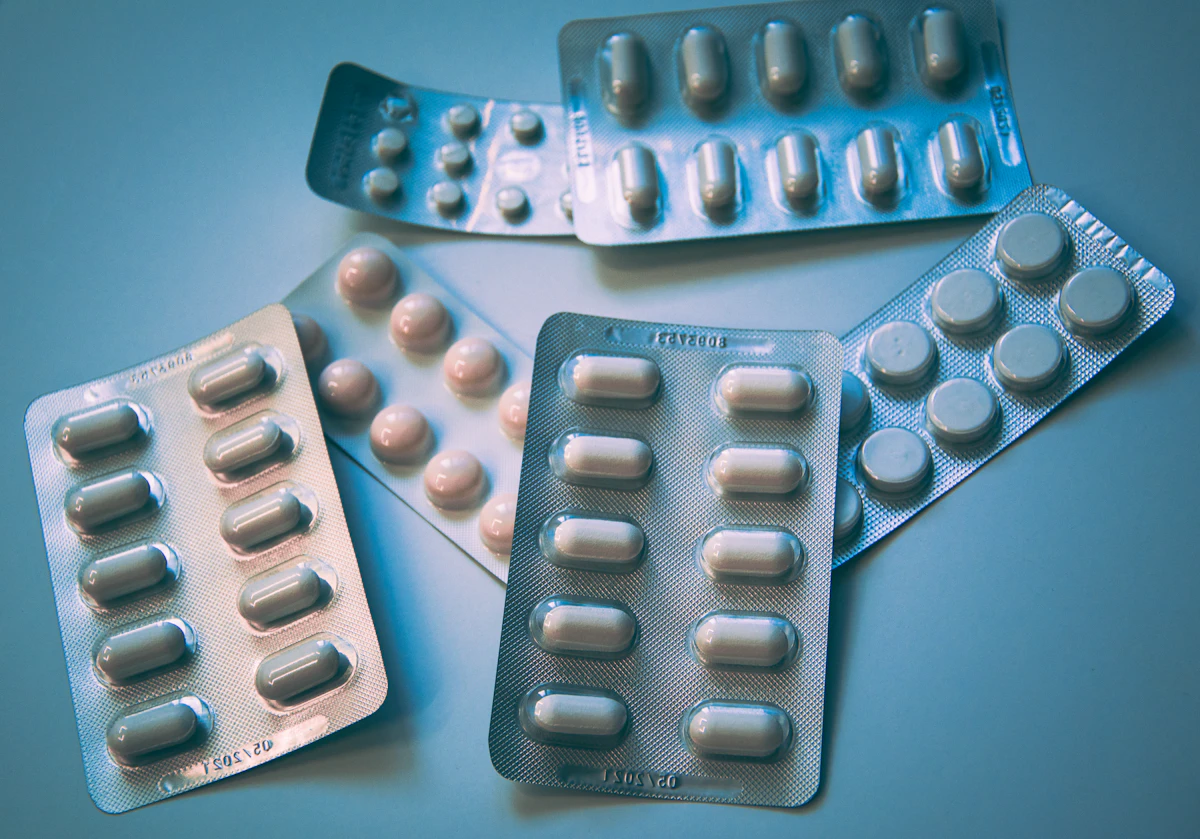
Biological half-life — also called elimination half-life — is the time it takes for the concentration of a drug, chemical, or radioactive substance to fall to half of its initial value within a living organism. This concept is central to pharmacology and medicine.
When a medication enters your body, your liver, kidneys, and other organs begin breaking it down and eliminating it. The rate at which this happens determines how long the drug stays effective — and how often you need to take a dose.
How Biological Half-Life Differs from Physical Half-Life
Three Types of Half-Life in Medicine
- Physical half-life (t½): The time for a radioactive isotope to decay by half, based purely on nuclear physics.
- Biological half-life (t_b): The time for a living body to eliminate half a substance through metabolism, excretion, etc.
- Effective half-life (t_eff): Combines both. Used for radioactive drugs given to patients. Formula:
1/t_eff = 1/t½ + 1/t_b
Drug Half-Life Examples
| Drug / Substance | Approximate Half-Life | Significance |
|---|---|---|
| Aspirin | 15–20 minutes | Clears quickly; short dosing effect |
| Ibuprofen | 1.8–2.5 hours | Taken every 4–6 hours for sustained pain relief |
| Caffeine | 3–5 hours | Explains why late-day coffee disrupts sleep |
| Paracetamol (Acetaminophen) | 1.5–3 hours | Requires regular dosing to maintain effect |
| Diazepam (Valium) | 20–100 hours | Long-acting; accumulates with repeated use |
| THC (Cannabis) | ~20–30 hours | Detectable in urine much longer due to fat storage |
| Alcohol (Ethanol) | ~4–5 hours | Eliminated at fixed rate (~one unit/hour) |
Doctors use biological half-life to calculate safe and effective dosing schedules. A drug with a very short half-life must be taken frequently to maintain a therapeutic level in the blood. A drug with a long half-life can be taken once daily or even weekly. Understanding this concept is critical for patient safety — getting the dose timing wrong can lead to drug toxicity or treatment failure.
Chemistry
Half-Life in Chemical Kinetics
In chemistry, the half-life concept extends to reaction kinetics — the study of how fast chemical reactions occur. The half-life of a reactant is the time needed for its concentration to fall to half of its starting value during a chemical reaction.
Importantly, the relationship between half-life and concentration depends on the order of the reaction. This is one key area where chemical half-life differs from nuclear half-life.
Zero-Order Reactions
In a zero-order reaction, the rate does not depend on the concentration of the reactant. The concentration decreases linearly over time. The half-life formula is:
First-Order Reactions
In a first-order reaction, the rate is directly proportional to the reactant's concentration. This is the most common type in nuclear decay and many biological processes. The half-life is constant — independent of initial concentration:
Second-Order Reactions
In second-order reactions, the rate is proportional to the square of the concentration. Here, the half-life increases as the reaction proceeds (as concentration drops):
Summary: Reaction Order vs. Half-Life Behaviour
- Zero-order: Half-life decreases as concentration decreases
- First-order: Half-life is constant (most like radioactive decay)
- Second-order: Half-life increases as concentration decreases
Real-World Uses
Real-World Applications of Half-Life
Half-life is not merely a classroom concept — it has profound, tangible applications across nearly every field of science and technology. Below are some of the most important areas where half-life plays a decisive role.
Radiocarbon Dating
Scientists use Carbon-14's 5,730-year half-life to determine the age of ancient organic materials — bones, wood, textiles — up to about 50,000 years old.
Medical Imaging
Technetium-99m (6-hour half-life) is the world's most-used medical radioisotope. Its short half-life minimizes patient radiation exposure during scans.
Drug Dosing
Pharmacists calculate drug half-lives to design dosing schedules that maintain therapeutic blood concentrations while avoiding toxicity.
Environmental Monitoring
After nuclear accidents, scientists use isotope half-lives (e.g., Cesium-137: 30 years) to predict contamination timelines and safe re-entry periods.
Nuclear Energy
Nuclear fuel rods use uranium and plutonium. Understanding their half-lives helps engineers manage reactor output and long-term nuclear waste storage safely.
Cancer Radiotherapy
Cobalt-60 and Iodine-131 are used to deliver targeted radiation to tumors. Their half-lives are carefully matched to treatment durations.
Food Irradiation
Controlled radiation from short-lived isotopes extends food shelf life by eliminating bacteria and pathogens. Half-life calculations ensure no residual radioactivity remains.
Geological Dating
Uranium-lead and potassium-argon dating use billion-year half-lives to date rocks and minerals, revealing Earth's 4.5-billion-year history.
Clearing Up Confusion
Common Misconceptions About Half-Life
Half-life is often misunderstood, even by students who have studied it before. Here are some of the most widespread misconceptions — and the correct explanations:
Misconception 1: "After two half-lives, a substance is completely gone."
- Reality: After two half-lives, only 25% of the substance remains. After ten half-lives, about 0.1% remains. Mathematically, the quantity approaches — but never truly reaches — zero in exponential decay.
Misconception 2: "Half-life tells us when exactly an atom will decay."
- Reality: Radioactive decay is probabilistic. Half-life tells us the probability that a given atom will decay within that time — not the exact moment. A single atom with a 1-second half-life has a 50% chance of decaying in the next second, not a guarantee.
Misconception 3: "You can change a substance's half-life in a lab."
- Reality: For nuclear (radioactive) half-life, no chemical or physical conditions can alter the decay rate. However, for biological and chemical half-lives, temperature, enzymes, and environment do matter — these are not nuclear processes.
Misconception 4: "Half-life only applies to radioactive materials."
- Reality: Half-life is a universal property of any exponentially decaying system — drugs in your bloodstream, reactants in a chemical flask, electric charge in a capacitor, and even the decay of social media trends all follow half-life logic.
Frequently Asked Questions
Half-Life FAQs: Student Questions Answered
What is the simplest definition of half-life?
Half-life is the time it takes for half of a given amount of a substance to decay, break down, or be eliminated. After one half-life, 50% remains. After two, 25% remains. And so on.
What is the half-life of Carbon-14?
Carbon-14 has a half-life of approximately 5,730 years. This is why it is used to date organic remains — bones, wood, charcoal — up to about 50,000 years old.
Does half-life change over time?
For radioactive (nuclear) decay, no — the half-life is a fixed, constant property of the isotope that does not change under any external conditions. For biological or chemical half-lives, yes — they can vary based on temperature, enzyme activity, and other factors.
What is the difference between physical and biological half-life?
Physical half-life refers to nuclear decay of a radioactive atom — purely a property of the atomic nucleus. Biological half-life refers to how quickly a living organism eliminates a substance through metabolism and excretion. A drug can have a biological half-life of 6 hours even if its radioactive component has a much longer physical half-life.
What happens after 10 half-lives?
After 10 half-lives, approximately 0.098% of the original substance remains — less than one-thousandth of the original amount. In most practical contexts (especially in medicine and nuclear safety), a substance is considered negligible after 5–10 half-lives.
What is a decay constant?
The decay constant (λ) is the probability per unit time that a single radioactive atom will decay. It is directly related to half-life by the formula: λ = 0.693 / t½. A larger decay constant means faster decay and a shorter half-life.
Why is half-life important in nuclear waste management?
Nuclear waste contains radioactive isotopes with varying half-lives — from seconds to millions of years. Engineers must store waste safely until it decays to harmless levels. Knowing the half-lives of waste components determines how long and what type of storage is needed — some nuclear waste must be stored for over 100,000 years.
Is half-life the same as shelf life?
No, though they are conceptually related. Shelf life refers to how long a product remains usable or effective (food, medications, batteries). Half-life is a precise scientific measurement of exponential decay rate. In pharmacy, drug half-life does inform expiry dating, but shelf life also depends on chemical stability, storage conditions, and packaging — not just half-life.
Post a Comment